EXTRA 10% OFF ON FIRST ORDER
PRE-SALES
Currency




- $259.00 USD
$290.00 USD- $259.00 USD
- Unit price
- per
Couldn't load pickup availability

CaDA AMG GT3 RC Conversion: What to Consider Before You Buy
Size Changes the Project
The AMG GT3 is a wide, densely built race car, and its physical size shapes every stage of the motor conversion. The larger chassis means longer sections of bodywork to lift away, heavier subassemblies to support, and less room to improvise on the bench. Rather than treating it as a bigger version of a compact model, approach the rebuild in layers: clear the interior, mark the original mounting points, and keep the body panels separate from the drivetrain parts. A tidy workspace and a patient sequence matter far more here than rushing the first test run.
Why the Original Drivetrain Has to Go
The stock gearbox and piston assembly are built for slow demonstration runs, not for the torque of a brushless system. Under sustained load they become the weak link, with the potential to slip, strip, or lock up mid-drive. The fix is to remove that complete path and rebuild it around parts that can handle the power: a brushless motor, a metal planetary gearbox, and a metal differential. The exterior keeps its GT3 identity while the mechanical backbone is brought up to match it.
Managing a Large Car at Speed
A car this size carries momentum. It tracks beautifully on long straights, but it needs distance to slow down and a wide arc to turn cleanly. Choose a venue with room to move, and treat every input as deliberate—soft throttle, smooth steering, and no sudden corrections. Build up a rhythm before increasing speed. When the car starts to feel light or twitchy, back off and reset, because a heavy model gives you less time to recover.
Battery, Run Time, and Heat
The brushless setup pulls genuine current, and heat builds faster inside a large, enclosed chassis. Charge the battery to full before each session, keep the connector seated firmly, and give the electronics a break between hard runs. A short warm-up lap brings the motor and ESC up to temperature gently instead of shocking them with an immediate full-throttle launch. That routine protects both run time and long-term reliability.

Protecting the Bodywork
The front splitter, rear wing, and flared arches define the GT3 look, but they are also the first pieces to find a wall or curb. Run on smooth, dry ground, give the car a generous safety margin, and pause before the battery runs out if the surface starts to collect dust or grit. After each session, check the panels, push on the wheels to feel for play, and make sure everything still rotates freely. Small catches are easier to fix the moment they appear.
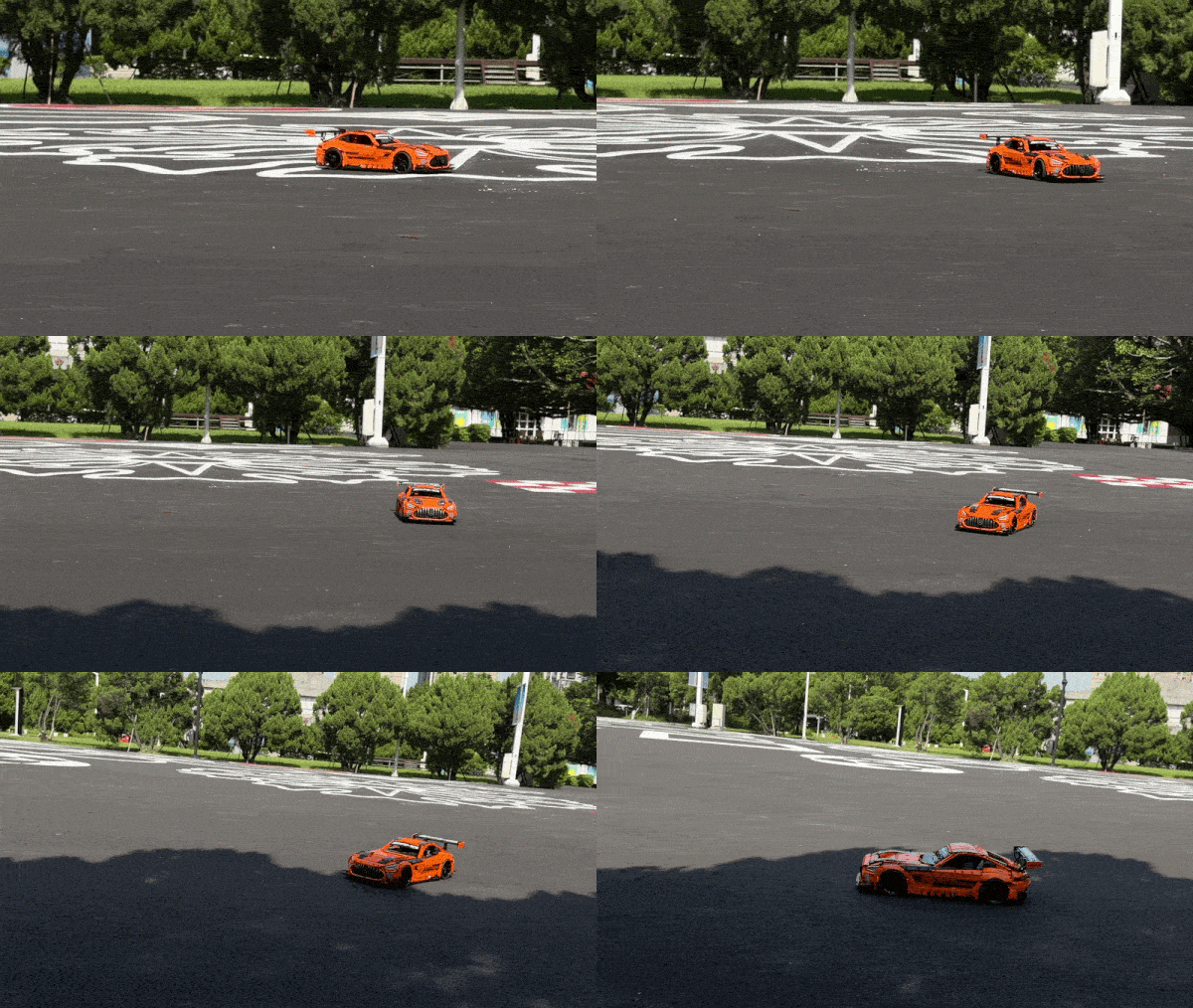
A Performance Rebuild, Not a Toy Upgrade
If the GT3 is already a favourite build, the motor conversion gives it a second life as something you drive rather than display. It calls for the same patience as the original assembly, but the reward is a machine that accelerates, steers, and stops with real intent. For builders who enjoy the mechanical process as much as the result, the C64008W is a platform that rewards the effort.
What the Conversion Actually Involves
This is a targeted rebuild, not a complete redesign. You will open part of the chassis, remove the original drive components, and route the new electronics through the existing frame. Before starting, set aside a full block of time, label or bag every part you remove, and follow the stages in order. Working this way keeps the drivetrain clean and cuts down the troubleshooting you will do later.
Super Power Functions Kit includes:
- PDF Instruction and On-line guide
- Modified building block bag
- Metal shaft
- Aluminum alloy universal joint
- Bearing drive axle
- RC metal differential
- 500W brushless motor
- Brushless ESC
- RC Level Servo Motor
- High-speed steering gear
- 1300mAh 3s lithium battery
- Lithium battery charger
- Battery voltage display
- Remote control
- Receiver
- Small drill bit (for drilling the wheel and fixing the drive axle)

Learn the Car Before You Chase Speed
The first run should be about proving the car works, not about setting a personal best. Roll it forward slowly, check that the wheels spin freely, and confirm the steering centers before touching the throttle hard. Add speed only when the car tracks straight and responds predictably. Once that foundation is solid, set up a few markers and work toward consistent lines instead of outright pace.
Built with care and driven with respect for its size, the conversion transforms a detailed display model into something that feels alive on the move—and the result is worth every step of the rebuild.
| Product Name | CaDA Master Mercedes-AMG GT3 |
| Pieces | 5,466 |
| Release Date | December 10, 2025 |
| Category | CaDA Master (1:8 scale, officially licensed) |
| Set Number | C64008W |
About CaDA AMG GT3
The Mercedes-AMG GT3 is one of the most successful customer racing cars of the modern GT era, and the CaDA Master interpretation treats the subject as a genuine flagship. Released on December 10, 2025, the 5,466-piece model is an officially licensed 1:8-scale build that captures the wide arches, the deep front splitter, the rear wing, and the aggressive racing stance that define the real car. It is a substantial project even before any powered upgrade is considered, and the finished model has a presence that smaller brick-built racers cannot match.
The GT3 class is built around a simple idea: a road-going sports car transformed into a dedicated circuit machine. That transformation shows in the CaDA model's proportions. The long hood, the cabin pushed toward the center, and the enormous rear wing all communicate speed, while the detailed bodywork rewards builders who enjoy assembling a car that looks correct from every angle. The livery and racing details give the set an authentic motorsport character rather than the feel of a generic supercar.
A brushless conversion moves that character from the display shelf to the ground. The upgrade concentrates on the chassis and drive path while leaving the original brick-built body and racing shape in place. The brushless motor and metal differential replace the basic push-along drivetrain, so the finished car gains proper throttle, responsive steering, and a drivetrain built for repeated high-speed running. The result keeps the AMG GT3's identity while adding the performance a static model cannot provide.
The original gearbox and piston assembly are removed during installation, because the stock parts are not designed to survive brushless torque. For builders who enjoy the set's engineering, that is a deliberate exchange: the visible details remain, while the hidden drivetrain is rebuilt for repeated use. The modification follows the chassis rather than requiring a full teardown, so a completed model can be converted with partial disassembly.
The car's substantial size and weight shape how it should be driven. It rewards open, smooth running areas where the long wheelbase can be managed safely, and where the detailed bodywork is not exposed to gravel, moisture, or close walls.
ZENE Superpower Kit from Display Build to Track Machine CaDA AMG GT3 is made for builders who want more than a static shelf model, born for high speed and professionalism. Once installed, the car gains proper throttle, responsive steering, and a drivetrain built for repeated high-speed running. The conversion keeps the original brick-built body and racing shape while replacing the basic push-along experience with full remote control.
- Top speed exceeds 20km/hr.
2445 Brushless Motor
With the 3s (11.1V) battery provided in the kit
Motor maximum rotation speed is 50000 RPM
16:1 Metal planetary gearbox. - It allows you to control the car smoothly on an open track.
600 meters anti-interference.
Latency average about 100ms - After high speed, the structure remains stable and will not be affected.
Alloy wear < 0.1% - Detailed building block step diagram instructions. Novices can easily complete the modification.
- Full charge about 15 minutes run. If full high-speed operation about 10 minutes.
- Unable to retain the original car gearbox and piston cylinder (original parts cannot support such high speed).
An exclusive solution, exciting gift, featuring brushless motors for rapid power modification and super high speed. Complete your build with this must-have kit for a uniquely premium experience. If you have been looking for a CaDA AMG GT3 motor kit, this AMG GT3 remote control conversion kit is the clean way to motorize the CaDA AMG GT3 building block car.
High-Performance Drive System
At the center of the conversion is a brushless motor paired with a reduction gearbox. Compared with a standard brushed motor, this setup provides stronger acceleration, smoother power delivery, and better efficiency during longer driving sessions. The reducer transfers the motor’s output into usable wheel torque, helping the car launch cleanly without relying on an oversized gear ratio.
A dedicated ESC manages motor speed and braking response. Rather than switching abruptly between stopped and full power, the system allows progressive throttle control. You can ease the car away from the starting line, hold a steady speed through a corner, or apply more power as the track opens up.
The included LiPo battery supplies the current needed by the brushless system. It fits into the converted chassis without changing the overall racing profile of the AMG GT3 model. Battery performance is most consistent when the pack is fully charged and securely connected before each run.
Competition-Style Steering
A servo motor controls the front-wheel steering. This gives the car a more direct response than a simple motor-and-return mechanism. Small controller movements produce measured steering adjustments, which is useful when lining up for a corner or correcting the car during a fast straight.
The 2.4GHz remote system helps maintain a stable connection with low input delay. Steering and throttle are controlled independently, allowing you to build speed gradually rather than treating the model like an on-and-off toy. The result feels closer to a hobby RC car while keeping the body and structure of a brick-built GT racer.
A separate receiver handles the signals from the transmitter and passes them to the ESC and steering servo. This modular layout also makes troubleshooting and maintenance easier because the main electronic components can be checked individually.
Metal Drivetrain Support
Higher speed puts more stress on gears, axles, and differential parts. For that reason, the kit includes a metal differential designed to handle the output from the brushless motor. It distributes power between the driven wheels while allowing them to rotate at different speeds through a turn.
This matters during track driving. Without proper differential action, the inside tire may drag, the rear of the car may become unstable, and the drivetrain may bind under load. The upgraded component helps the car enter corners more naturally and improves consistency when accelerating out of them.
The motor reducer and metal drivetrain parts also reduce the risk of plastic components slipping under heavy acceleration. Careful assembly is still important. Gears should move freely, axles should remain straight, and cables must be routed away from rotating parts.
Build Your Own Race Session
A smooth indoor floor, empty warehouse area, clean driveway, or prepared RC course all work well for testing the upgraded model. Start with low throttle and check steering alignment before attempting full-speed runs. Once the car tracks straight, you can set up cones, create a small circuit, or run timed laps with another builder.
The system is also suitable for filming. Slow rolling shots show the body details clearly, while faster passes add real movement to product videos. Controlled acceleration makes it easier to repeat the same scene without pushing the car by hand.
For the best results, avoid loose gravel, deep water, wet grass, and heavy dust. The car is built around a detailed brick chassis rather than a sealed off-road platform.
Will the kit fit my completed AMG GT3?
Yes. The conversion is designed around the existing CaDA AMG GT3 chassis. You will partially dismantle the finished car, follow the illustrated steps, and rebuild the relevant chassis sections around the new drivetrain rather than reducing the model to loose parts.
Does the original gearbox and piston engine stay in place?
No. The original gearbox and piston cylinder are removed during installation. They are engineered for display and light demonstration, not for the sustained speed of a brushless system.
What performance should I expect?
The converted AMG GT3 can exceed 20 km/h with the supplied 3S battery and 2445 brushless motor. The 16:1 metal planetary gearbox converts the motor's high RPM into usable wheel torque, while the metal differential improves cornering stability.
Is this a realistic first conversion?
The kit includes detailed building-block step diagrams aimed at newcomers. Work methodically through the chassis, keep cables clear of rotating parts, and check steering alignment before full-speed runs.
Related Products
- $259.00 USD
$290.00 USD- $259.00 USD
- Unit price
- per
- $259.00 USD
$290.00 USD- $259.00 USD
- Unit price
- per
- $259.00 USD
$290.00 USD- $259.00 USD
- Unit price
- per
- $259.00 USD
$290.00 USD- $259.00 USD
- Unit price
- per
- $259.00 USD
$290.00 USD- $259.00 USD
- Unit price
- per
- $259.00 USD
$290.00 USD- $259.00 USD
- Unit price
- per
- $259.00 USD
$290.00 USD- $259.00 USD
- Unit price
- per
- $259.00 USD
$290.00 USD- $259.00 USD
- Unit price
- per
- $259.00 USD
$290.00 USD- $259.00 USD
- Unit price
- per
- $259.00 USD
$290.00 USD- $259.00 USD
- Unit price
- per
Power Functions Series
Latest Posts
- Choosing a selection results in a full page refresh.